
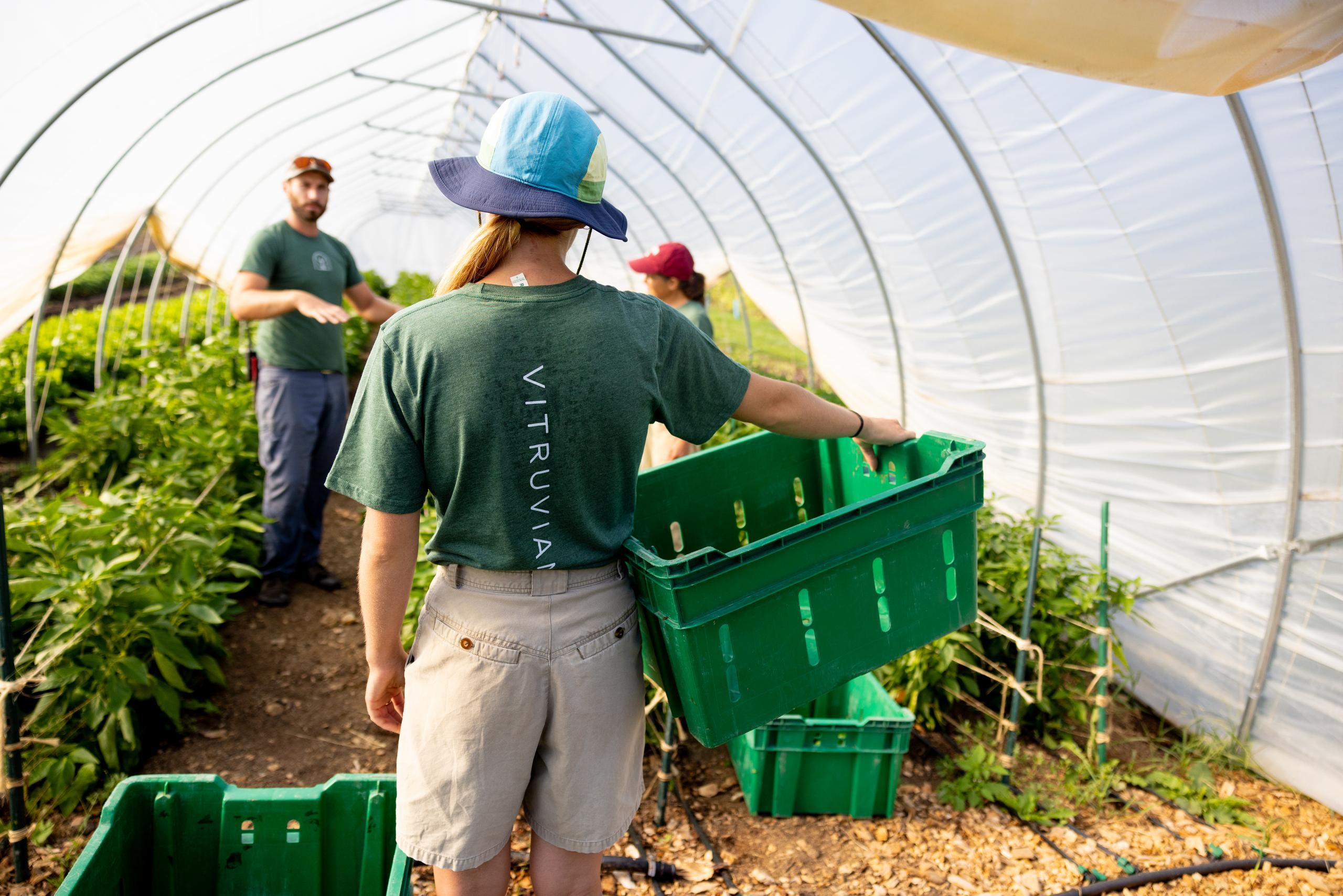
The Vitruvian Farms store boasts a sign out front: “95% of what’s in this store is Wisconsin-made.”
I met Tommy Stauffer, co-owner and co-founder, inside. Surrounded by brilliant rows of vegetables from the fields out back, loaves of bread baked only a few miles away, and freezers filled with meat raised and butchered just down the road, it’s hard not to feel just a little bit hungry. Tommy’s pride in the food is clear. “When you walk in here, it’s a true celebration of local,” he says.
Tommy and his partner, Shawn Kuhn, never planned to be farmers. Fresh from their senior year of college, the idealistic duo decided to start a farm built on regenerative agriculture principles and a deep sense of community. Never mind the fact that neither of them had an ounce of farming experience.
That was 15 years ago. Vitruvian Farms is now a thriving staple of the Madison, Wisconsin, area. Located 9 miles outside the city on 46 acres, the farm nurtures flourishing fields of organic produce, an indoor mushroom growing facility, and a farm store offering goods from producers throughout the state.

Learning on the Fly
Shawn and Tommy began building out the business structure for their farm in 2010. By the following growing season, they were all in.
“From the first day I met him, Shawn was extremely vocal about problems that he saw around him … [including] food quality,” Tommy says. “Really, the goal was that we wanted to relocalize the food system and grow food that was void of harmful chemicals.”
The pair learned through books, YouTube videos, and a lot of trial and error. “It would have probably been wiser to work on an organic farm for a year or two first … we did a lot of silly things at the beginning,” Tommy says, with a laugh.
Among those early learning experiences was one particularly memorable episode: they decided to heat their brand-new greenhouses with a wood-burning stove that was located inside the greenhouse. It was immediately flooded with smoke, sparking the joke that they were growing the first-ever smokehouse greens. Safe to say, they turned to more modern heating methods after that.
Finding Stability Through Community
When the area received record rainfall in 2018, Tommy and Shawn were left with flooded fields full of rotting salad greens. The farm lost nearly one-sixth of its annual income in a few short weeks; Tommy and Shawn knew they had to pivot to a crop that wasn’t weather-dependent.
They soon added an indoor mushroom-growing system, bolstering the farm’s financial and climate resilience. The fresh shiitake, oyster, and lion’s mane mushrooms appealed to local chefs. Now, it’s tough to find a menu that doesn’t boast greens and mushrooms grown by Vitruvian Farms: Tommy and Shawn partner with more than 70 restaurants throughout Madison.
But when the COVID shutdown left Vitruvian Farms with a backlog of vegetables and a brand-new farm store that was now closed to shoppers, Shawn and Tommy had to hatch another community-oriented solution.
Tommy’s first call was to local chef Evan Dannells. “We sat down over a few beers and formed this idea,” he says. “Let’s turn our produce into take-home freezer products.” Soon, Evan was whipping up pesto from Vitruvian’s basil and turnip greens and stuffing breakfast burritos with peppers and tomatoes from their greenhouses.
The proceeds kept both businesses afloat, and the partnership is still going strong today. The farm has since made local food even more accessible by offering online ordering and home deliveries in addition to a traditional Community Supported Agriculture (CSA) program.
Tommy says Vitruvian Farms’s guiding principle has always been to support those around them. “We want to bring all these businesses around us up and build relationships, build friendships, and make a resilient food system that is available to our community.”