
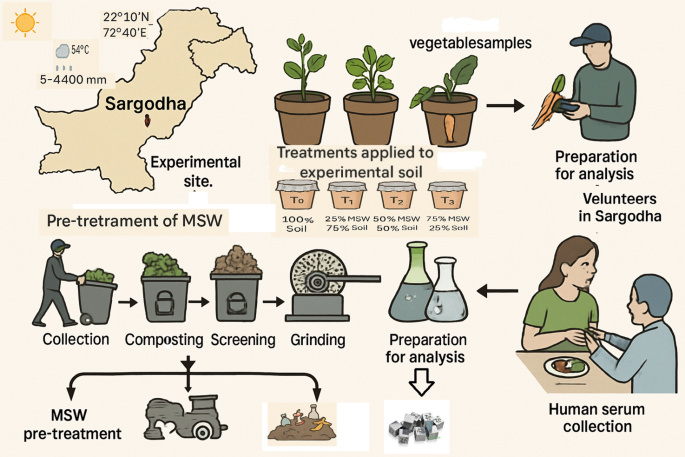
Experimental site
The current study was carried out in the Sargodha region, which is located at 72° 40’ E and 32° 10’ N. The climate of the research region is local steppe, with average temperatures ranging from 25 to 49 °C in summer and 5 to 23 °C in winter. The average annual rainfall in this area is approximately 200–400 mm. On the basis of on the soil texture, meteorological conditions, and agronomic practices used in the study region, the Sargodha area is classified as a Central Mix Cropping Zone of Punjab, Pakistan.
Experimental design
All experimental protocols were approved by the Institutional Human Ethics Committee of the University of Sargodha (Approval No. 25-A18 IEC UOS). The study was structured in a completely randomized design (CRD), and included four treatments, fifteen vegetable species, and five replications per treatment. The experiment was conducted over two consecutive growing seasons—the first in 2017 and the second in 2018.
The four soil treatments applied were as follows:
-
T0 (Control): 100% clean garden soil.
-
T1: 25% municipal solid waste (MSW) compost + 75% clean soil.
-
T2: 50% MSW compost + 50% clean soil.
-
T3: 75% MSW compost + 25% clean soil.
Each pot was filled with 12–14 kg of the respective soil mixture, and all treatments were applied to each of the 15 vegetable species, resulting in a total of 300 pots per season. The experimental conditions, treatments, and crop types remained consistent across both years. The pots were maintained under open field conditions with natural sunlight exposure and irrigated manually every two days. The vegetation period ranged between 85 and 120 days, depending on the crop species (Fig. 1A–C). Thinning was carried out 15 days after germination to ensure proper plant spacing and minimize competition11.
Composting of MSW
Municipal solid waste (MSW) is sourced from various locations in Sargodha, including garbage disposal sites, fruit and vegetable markets, and waste collection canals. The composting process adhered to a standard aerobic decomposition protocol. Initially, the collected waste was sorted to remove non-biodegradable components such as plastics, metals, stones, and glass. The remaining organic matter was arranged in windrows and turned weekly to promote aeration and ensure uniform decomposition. The moisture level was maintained between 50% and 60%, and internal temperatures were regularly monitored to sustain thermophilic conditions (55–65 °C) during the active composting phase.
The composting process lasted for 8–10 weeks, followed by a curing (maturation) period of approximately 4 weeks to allow the compost to stabilize. After maturation, residual coarse materials were removed, and the compost was air-dried.
To ensure consistency across treatments in the experimental setup, the matured compost was lightly ground using a mortar and pestle and sieved through a 2 mm mesh. While this degree of preparation does not reflect typical field-scale compost use, it was carried out to standardize the texture and facilitate homogeneous mixing in controlled pot experiments. The processed MSW compost was subsequently mixed with garden soil in specific ratios for experimental application12,13.
Treatments applied to the experimental soil
The soil in the pots had a loamy texture. In this experimental study, various treatments were applied to assess their impact on soil composition. The control group denoted as T0, represented the baseline condition, consisting of 100% soil without any additional amendments. To investigate the effects of municipal solid waste (MSW) incorporation, three different treatment groups were established. In T1, the soil mixture was composed of 25% MSW and 75% soil. In T2, the ratio was adjusted to 50% MSW and 50% soil, whereas in T3, 75% MSW was combined with 25% soil.
These treatments allowed the examination of how different levels of MSW integration influenced soil properties and composition, providing valuable insights into potential environmental and agricultural implications. All of the pots were wrapped in aluminum foil with six small holes to maximize gas exchange and minimize moisture loss from the soil. All the treatments were incubated at 25 °C for 20 days Chaturvedi and Sankar14.
Vegetable cultivation
Seeds of commonly grown vegetables were procured from the Ayub Agricultural Research Institute, Faisalabad (Table 1). In each pot (top diameter: 33 cm; base diameter: 25.5 cm; height: 30 cm), ten seeds of each vegetable species were sown. After germination, thinning was performed 15 days after sowing to minimize plant competition and ensure optimal spacing.
The experiments were conducted during the spring–summer growing seasons (March-June) of 2017 and 2018. Each crop had a vegetation period ranging from 85 to 120 days, depending on the species. The pots were maintained under natural sunlight in an open experimental area, with manual irrigation every two days to maintain adequate soil moisture. The ambient temperatures ranged from 25 °C to 42 °C, with relative humidity between 40 and 70% throughout the growing period.
These cultivation conditions demonstrated the adaptability of diverse vegetable species to MSW-amended soils, highlighting the potential of such practices for sustainable agriculture. The staggered sowing and harvesting schedules ensured a continuous production cycle, contributing to food security in the region and demonstrating the viability of MSW-based organic cultivation strategies. (Fig. 1D).
Soil and vegetable collection
Soil samples were taken from the center of each pot. Vegetable samples were obtained at the point where they were consumed by humans. To eliminate externally deposited pollutants, these samples were rinsed with de-ionized water. The samples were then cut into small pieces for drying. All the soil and vegetable samples were dried in open air before being placed in an oven at 650 °C for nearly 72 h15. The samples were then ground into a fine powder for digestion.
Physico-chemical analysis
Before the seeds were planted, physico-chemical analysis of all the soil treatments, including soil pH, EC, saturation percentage, available potassium, organic matter, and available phosphorus, was performed16.
Serum sample collection
The Institutional Human Ethics Committee of University of the Sargodha (Approval No.25-A18 IEC UOS) approved all the protocols used in this experiment. Following informed consent, 120 subjects were recruited for the study. The same volunteers were chosen from four different sites in Sargodha throughout two growing years. Site 1 was chosen because the locals consumed groundwater-irrigated vegetables. Sites 2, 3, and 4 were chosen because people unintentionally ate tainted vegetables. People in that neighborhood had been eating tainted vegetables for more than ten years. Human blood (15 ml) was taken from participants’ median cubical veins using 1% sodium heparin as an anticoagulant. To obtain the serum, all the samples were centrifuged at 2000 rpm for 10 min. Serum samples were then refrigerated at -20 °C for metal analysis (Fig. 1D).

(A–D) Graphical Abstract (A) The study site is located in the Sargodha region, Pakistan (72°40′E, 32°10′N), characterized by a local steppe climate (B) Municipal solid waste (MSW) was collected, composted through aerobic fermentation, and ground into a fine powder (C) Fifteen vegetable species were cultivated in pots under different MSW-soil ratios to assess growth and adaptability (D) Serum samples were collected from subjects.
Sample digestion
All of the samples were digested with HNO3 and H2O2. 1 gram of each sample (soil and vegetable) was placed in a flask, and 5 ml of concentrated nitric acid was added to it. This solution was maintained in the refrigerator for at least 24 h. Add 4 ml H2O2 to the solution and heat it for an hour on the hotplate. The samples were then digested with H2O2 until a clear solution was formed in the flask. The digested samples were allowed to cool at ambient temperature before being filtered through Whatman filter paper 42. The addition of distilled water yielded a final volume of 60 ml. For digestion, a 250 L serum sample, 300 L concentrated nitric acid (HNO3), 200 L concentrated hydrochloric acid (HCl), and 100 L hydrogen peroxide (H2O2) solutions were utilized. Deionized water was added to achieve a final volume of 2.0 mL17.
Analysis of metals
All the chemicals used were of analytical grade. Double deionized water was used for sample dilution and reagent preparation. The selected metals were analyzed via an Atomic absorption spectrophotometer (Perkin Elmer model 2000, USA). Different working standards were made from the Perkin Elmer standard stock solutions (1000 ppm) used for the determination of metal. The detection limits imit of 2 µgcm–3 and wavelengths 213.9 nm were used. For precision and accuracy of analytical work, the values of blank were subtracted from sample. Additionaly, quality control procedures were adopted to minimize contamination and enhance the reliability of data. Standards were run after every five samples, to ensure that the instrument was working properly.
Statistical analysis
The Shapiro-Wilk test was applied at the 5% significance level to assess the normal distribution of the data. We conducted statistical analysis, including analysis of variance (ANOVA), to determine significant differences between means and interactions. This involved a completely randomized design with two factors and one factor. Tukey’s Honestly Significant Difference (HSD) test was used at the 5% significance level for pairwise comparisons of significant factors. The statistical software packages SPSS 21, Minitab 18, and XLSTAT 2014 were employed for all analyses and graphical representations.
Pollution load index (PLI).
The pollution load index (PLI) was developed to assess the heavy metal status in polluted soil. It is determined by Li et al.18 formula:
$$\:\text{I}=\frac{M\:\left[AS\right]}{M\:\left[RS\right]}$$
(1)
M [AS] = Metal concentration in analyzed soil.
M [RS] = Reference metal concentration in the soil.
According to Ahmad et al.19 reference metal concentrations in the soil were employed.
Bioconcentration factor (BCF)
The quantity of metal concentration transferred from the soil to the edible section of vegetables was measured by the bioconcentration factor (BCF) index. It is determined by Cui et al.20 formula:
$$\:\text{B}\text{C}\text{F}=\frac{\text{M}\:\text{e}\text{d}\text{i}\text{b}\text{l}\text{e}\:\text{p}\text{a}\text{r}\text{t}}{\text{M}\:\text{s}\text{o}\text{i}\text{l}}$$
(2)
M edible part = Metal concentration in the edible portion of vegetables.
M soil = Metal concentration in the soil.
Enrichment factor (EF)
The following formula was used to calculate the enrichment factor Buat-Menard21. Standard metal concentrations in plants and soil were used, according to Ahmad et al.19.
$${\text{EF}}\,=\,\underline {{{\text{Metals }}({\text{vegetable}}/{\text{soil}})}}$$
(3)
Standard concentration of metals (vegetable and soil).
Daily intake of metals (DIM)
The daily intake of metals (DIM) index was developed to calculate the quantity of metal consumed by humans through a vegetable diet.
$$\:\text{D}\text{I}\text{M}=\frac{M\times\:K\times\:I}{W}$$
(4)
where M = Metal concentration in the vegetables.
K = Conversion factor which is 0.0852.
I = Daily intake of vegetables for the human which was 0.345 kg person− 1day− 1, respectively22.
W = Average body weight of a human that is 55.9 mgkg− 1 for an adult23.
Health risk index (HRI)
The health risk index (HRI) characterizes the potential health risks posed by metal-contaminated vegetables19,24 and employs an oral reference dosage of metals.
HRI=\(\:\:\frac{\text{D}\text{I}\text{M}}{\text{R}\text{f}\text{d}}\) (5).
DIM = Daily intake of metal.
Rfd= Oral reference dose of metal.