
While Canadians are taking time at the grocery store looking for Canadian-made products and labels like the maple leaf, local food growers are ramping up production to meet demand.
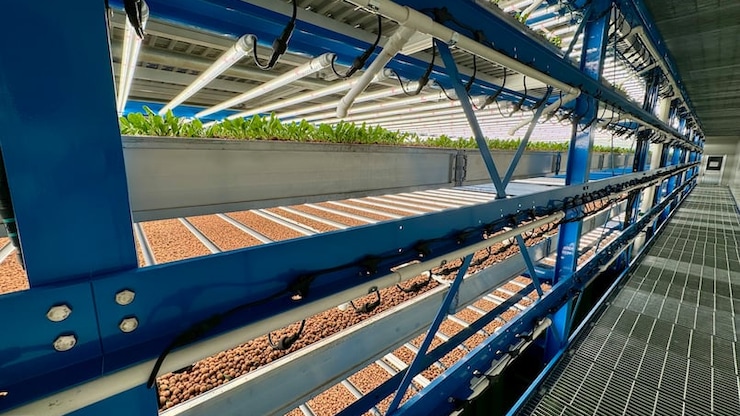
Jon Lomow is the co-founder of Fieldless Farms, an indoor vertical farm in Cornwall, Ont. He grows leafy greens and mushrooms year-round and says his produce has been flying off the shelf.
We are selling out two- to four-times faster, in some instances, maybe five-times faster in high volume stores, than we were before all this was happening. That’s a pretty strong sign that people have moved in the direction of wanting to buy more local,
Lomow told Cost of Living (new window).
They’re planning to build another farm to meet that rising demand, and started a crowdfunding campaign. The company has nearly hit their goal of $2.2 million in only a month.
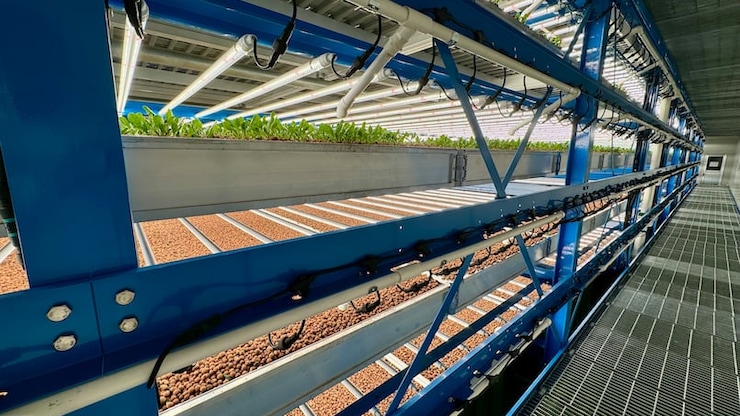
Spinach is seen growing in a vertical farm at Fieldless Farms in Cornwall, Ont. The company is crowdfunding money for a new vertical farm location. (Submitted by Jon Lomow)
Photo: (Submitted by Jon Lomow)
Pockets of food production in Ontario, Quebec, Alberta and British Columbia have led to greenhouse fruit and vegetable production volumes increasing by roughly five times since 2000, Royal Bank of Canada agricultural policy lead Lisa Ashton wrote in a report on agriculture and Canadian exports (new window).
This growing industry can play a critical role in closing the production gap, where vegetable production would need to double and fruit production would need to grow by five times to feed domestic demand, she wrote.
Steps to becoming self-sufficient
The suddenly rocky relationship between Canada and the U.S. has many Canadians rethinking our dependence on our southern neighbour.
Despite growing many fruits and veggies, Canada’s fleeting summer and short growing season means the country relies on the U.S. and other parts of the world for fresh produce to balance consumers’ nutritional needs — especially during the winter.
Lenore Newman, director of the Food and Agriculture Institute at the University of the Fraser Valley in B.C., said that for decades, importing produce from the U.S. was no big deal.
It was just very easy for a long time to rely on them. And, it just worked until it didn’t.
On average, about 50 per cent of vegetables, aside from potatoes, and 75 per cent of fruits eaten in Canada are imported, according to research (new window) from the University of British Columbia. And out of this, the U.S. supplies 67 per cent of Canada’s vegetable imports and 36 per cent of its fruit imports.
WATCH | Quebec announces plans to rely less on U.S. imports:
Bring on the baby carrots: Quebec unveils targeted plan to reduce U.S. food imports
April 10|Duration1:43The province is once again trying to get Quebecers to purchase locally. This time, the government is launching an ad campaign that includes wordplay referencing U.S. President Donald Trump, as well as offering financial support for a specific type of local food production.
The Dutch model of growing food
Newman says we could grow more produce year-round like producers in the Netherlands. Though the country is smaller than Nova Scotia, it is the second largest exporter of vegetables (new window) in the world after the U.S.
Dutch producers grow food in greenhouses with very little fertilizer, water and labour, and use a lot of solar-derived energy. In the Netherlands, roughly 5,500 hectares of land — or 2 million NHL hockey rinks — is dedicated to growing vegetables indoors.
And what prompted this has a lot to do with history.
During World War II, they had extreme hunger. They left that war never wanting to experience that again so they invested heavily in agricultural technology, in supporting their farm sector, and ensuring that they were an agricultural superpower,
Newman said.
Newman added that it can make sense economically to import the stuff that is difficult to grow in Canada.
You can grow anything year round, you just can’t do it and make any money. So it’s way smarter to buy oranges from Spain.
Time to focus on food security
It wasn’t always like this.
Canada used to produce a lot more fruits and vegetables. But after a free-trade agreement between Canada and the U.S. was signed in the late 1980s, fruit and vegetable processors moved to the U.S. where they could get year-round products, says Evan Fraser, director of the Arrell Food Institute at the University of Guelph. As a result, farmers in Canada stopped producing as many fruits and vegetables and simply started buying them from the U.S.
When it comes to livestock, protein and dairy, we produce lots and we’re not worried about those things.
The first thing we have to do in order to become more food self-sufficient is reinvest in fruits and vegetable processing facilities — canning, freezing, dehydrating — that would take a seasonal crop and allow us to keep them year round,
Fraser said.
The bad news is that this probably involves increased costs for healthy and nutritious food at a time when nearly nine million Canadians (new window) live in food insecure households, according to 2022 data from Statistics Canada.
I have a hard time imagining a scenario where it’s as affordable to produce things in Canada — at least in the short term — as it would be to produce them in California and ship them up,
Fraser said.
However, new technologies, like vertical farming and effective greenhouse equipment, are making it more economically efficient than ever before to produce fresh, healthy foods out of season in Canada, he said.
Can Canadian produce compete on price?
While getting into farming can be tough with all the red tape and soaring land costs, Gagan Singh, a blueberry farmer and local farming advocate got lucky when he inherited eight acres in Abbotsford, B.C.
He said learning to farm has been the hardest thing he’s ever done, but he has met a lot of young people who want to get their hands dirty.
Singh acknowledges it can be hard to compete with international producers.
Canadian farmers cannot compete against Chinese and Mexican farmers because everything’s cheaper there. They have less regulations, lower labour costs. The reason we’re importing so much is because people just want the best possible price,
Singh said.
Increasing the amount of year-round growing in Canada could help lower prices as supply increases, Singh says.
And while some consumers may be motivated by prices, he thinks that something has changed and others are open to spending a bit more.
I feel like a big bubble has burst for a lot of Canadians, and I think a lot of people are realizing how much stuff they’re buying is actually not from Canada,
he said.
There’s seeds that have been planted in the consumers’ heads. People are like, I don’t want to be dependent on America … and it was a really important kick in the butt that I think Canadians needed.
Samritha Arunasalam (new window) · CBC Radio ·