
Tribune News Network
Doha
In Qatar Foundation’s schools, sustainability isn’t just taught, it’s lived. From recycling used cooking oil to transforming organic waste into nutrient-rich soil for growing vegetables, students are showing how small, practical actions can create lasting environmental change – and help build a cleaner, greener future.
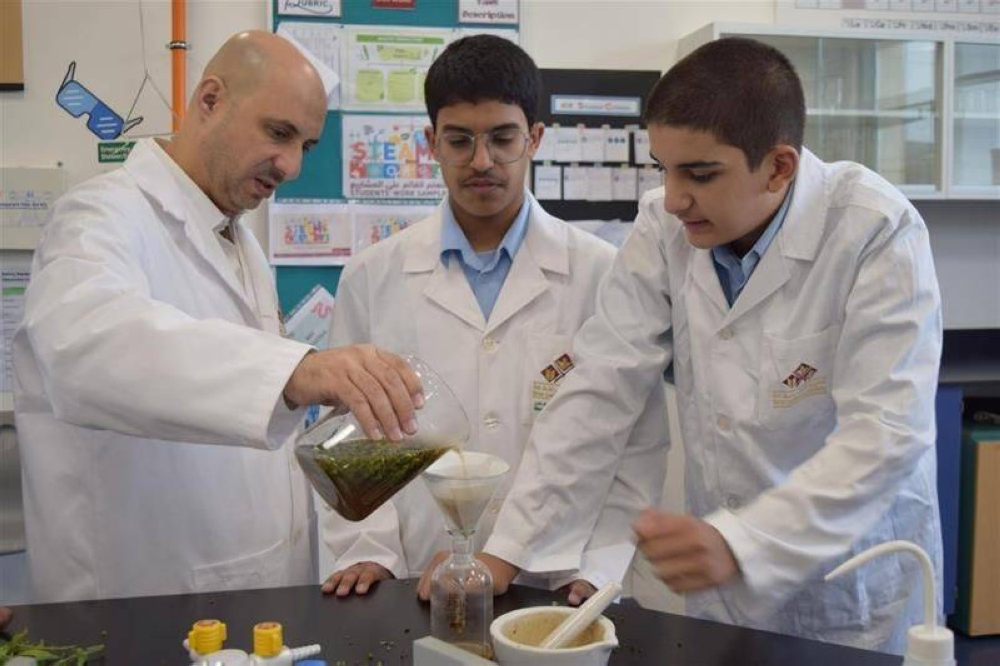
At Qatar Leadership Academy (QLA), part of Qatar Foundation’s (QF) Pre-University Education, a group of students are giving cooking oil, expired olive oil, and food waste a new purpose by using it to make eco-friendly soap and compost – turning everyday waste into products that benefit both their school, and the planet.
Saoud Abdulaziz Al-Muraikhi, a 15-year-old-student from Qatar, explains the recycling process. “First, we filter and clean the oil, then mix it with lye – sodium hydroxide for solid soap and potassium hydroxide for liquid soap,” he says. “Then we add natural fragrances made from basil, lemon, and rosemary leaves, and let the mixture rest until it becomes soap. Once it’s ready, we use the soap for cleaning in our school and share it during environmental awareness events.”
Reflecting on what the project has taught him and his fellow students, Al-Muraikhi says: “I learned that waste can become valuable when we think scientifically. It was amazing to see how simple kitchen oil can turn into soap and how food waste can become a compost that grows healthy plants. I also learned about chemical reactions and how sustainability can start from our own school.”
Meanwhile, at QF school Qatar Academy Sidra (QAS), students are cultivating herbs and vegetables, like lavender, tomato, mint, and lettuce, in their on-site garden through the ‘Greenhouse Initiative.’
Entirely student-led, its young participants collaborate to decide what to plant and how to care for the garden, while also monitoring growth and recording observations. They are encouraged to lead workshops, share their learnings with others, and propose new initiatives.
The ‘Greenhouse Initiative’ has also become an integral part of QAS’s Units of Inquiry, connecting learning across subjects. Students are applying science and math concepts in real-life contexts – exploring plant life cycles and sustainability, measuring growth, and representing data. Language and art lessons are supporting reflection and creativity through writing, sharing ideas, and designing projects with recycled materials. Next semester, the school aims to launch the Greenhouse Café to link learning with healthy, environmentally conscious food choices.
Maria Dahmali, aged 8, explains why she decided to join the programme, saying: “I got involved in the project because I love the idea of helping the earth and learning how things grow. One of our values at Qatar Academy Sidra is sustainability, so I wanted to live this value and do something positive for the environment.
“Working in the garden helps us appreciate how much effort goes into growing food, so we waste less. It shows us that scraps can become useful again. It makes us care more about the environment because we can see how plants and insects all work together to keep nature healthy.”
Part of the programme is learning about composting, and how everyday habits can make a difference. “I was surprised to learn how useful scraps can be,” says Dahmali. “Now I save things like vegetable ends and eggshells for compost instead of throwing them away, which helps reduce waste and feeds the garden.”
Sara Dawood, a teacher at QAS Primary School and part of the ‘Greenhouse Initiative’, says that encouraging young people to understand and embrace sustainability is essential, because habits formed early in life tend to last.
“Our school, being an International Baccalaureate school, plays a key role by providing experiences that connect knowledge to action, through activities like gardening, recycling projects, and eco-workshops,” she says. “Students learn that their choices matter, and, by doing this, schools can also nurture leadership, responsibility, and awareness.
“By helping students understand that sustainability is not just a subject but a way of life, by integrating these principles into the curriculum and school culture, we empower students to become environmentally conscious citizens who can positively impact their communities and the world.”