
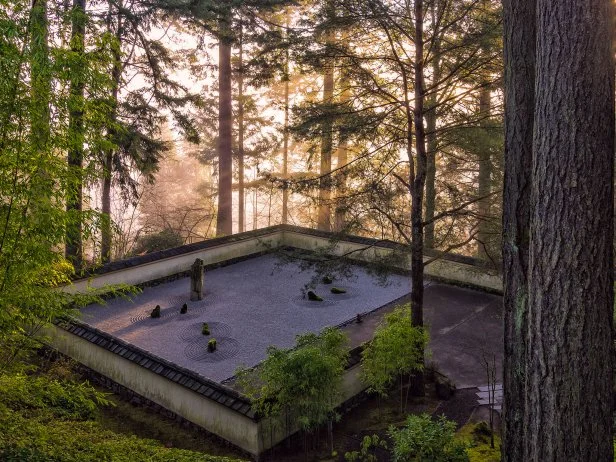
Could you use some balance and serenity in your life? A Japanese Zen garden can make your backyard–or any space– feel peaceful and calm.
History and Cultural Significance
Zen gardens originated in Japan centuries ago, after Zen Buddhism was introduced from China. But the term “Zen garden” wasn’t used until the 1930s, says Steven Pitsenbarger, Garden Supervisor at San Francisco’s Japanese Tea Garden at the Gardens of Golden Gate Park. Initially, the term referred to dry landscape gardens, or karesansui, made with sand and stones. It’s changed over time, he explains, to become a “catch-all” associated with meditation. Sometimes it’s used to describe other types of Japanese gardens as well as Japanese Zen gardens with untraditional features.
Today’s Japanese Zen gardens aren’t always associated with Zen Buddhism, Steven adds, but their purpose is the same: they’re intended to connect people to nature and help refresh, relax and restore them. “If the garden designer and the gardener have done their best work, then garden visitors will have these experiences with or without the influence of Zen.”
Key Principles of Zen Garden Design
Traditional Zen gardens are guided by the concepts of simplicity (Kanso), austerity (Koko), stillness (Seijaku), asymmetry (Fukinsei), naturalness (Shinzen), mystery or subtlety (Yugen) and the magical or unconventional (Datsuzoku).
Build your garden where it can be seen from a window or glass door, says Ayse Pogue, Senior Horticulturist at the Chicago Botanic Garden, where these kinds of features can be found in the Elizabeth Hubert Malott Japanese Garden. “The idea is to have the landscape look like a painting that changes with the seasons.”
The Benefits of Having a Zen Garden
One of the benefits of having a Zen garden is that its simplicity helps you focus inward, says Hugo Torii, Garden Curator and Director of the Japanese Garden Training Center at the Portland Japanese Garden. The routines of caring for it, such as raking, can encourage contemplation and meditation. “For some, such those who practice Zen Buddhism, it might bring spiritual comfort.”
Essential Elements of a Zen Garden
Authentic Zen gardens use stones, rocks, gravel and sand in white or muted grays, browns, blacks and greens. Raked patterns symbolize water, like waves and currents. Misty Frye, Administrator at Sholom Park, a botanical garden in Florida with a Japanese Zen garden, says, “This minimalistic, dry landscape design is meant to inspire reflection through simplicity.”
Types of Rocks and Stones to Use
Hugo suggests visiting a local landscaping supply store to see what kinds of stones are available for your Japanese Zen garden. “Choose materials that provide proportion, balance and flow, with appropriate color, texture and form. The most important element of this kind of private space is how it makes you feel. If it provides comfort to you, that is a success.” Don’t take stones from natural areas or wildlands, without permission from its governing agency.
Choosing the Right Plants for Tranquility
Raked gardens don’t usually have plantings, Hugo says, aside from incidentals like moss. “You do not need to necessarily buy plants that are Japanese in origin.” Portland’s garden uses many native species, like local ferns. If plants are used, Misty adds, “they’re usually chosen for simplicity, subtle color and seasonal beauty rather than bright flowers.” She recommends mosses, ferns, evergreens like pines and junipers, bamboo, maple trees, azaleas, camellias, topiaries and native or imported grasses.
Ayse says, “Plant choice should be based on growing conditions and availability for your region. More than plant species, what’s important is how they are pruned and how they look together as a composition.” The Malott Japanese Garden within the Chicago Botanic Garden “has boxwoods, cherry trees, hydrangeas, Mugo pines and crabapples.”
Incorporating Water Features for Serenity
Traditional Zen gardens omit water features, but “If you’re creating a Zen-inspired garden at home, you can absolutely adapt it to your taste,” Misty says. A fountain, pond, pool or other water feature “will change it from a traditional Zen garden to a more of a Japanese-style garden, but it can still capture the same peaceful, meditative feeling.”
Maintenance Tips for Zen Gardens
You’ll want to keep your Zen garden clean, and rake as needed when the patterns are altered or erased by wind, rain, wildlife or pets. “The majority of a gardener’s time is spent picking up leaves, removing weeds, and keeping the lines sharp,” Steven says, and you may need to prune any plants. Misty recommends gently brushing moss and periodically washing the algae and dirt off rocks. “There is no harm in regularly raking,” Hugo says, “especially if it provides comfort.”
Zen Garden Ideas for Small Spaces
“Avoid overcrowding with too many plants or ornaments; let negative space be part of the design,” Misty says. “Pick one focal point, like a single rock arrangement or small maple tree.” Go vertical with a screen, trellis or hanging planter, and choose dwarf or compact plants. Declutter your surroundings; “The calm effect works best when the area around your Zen garden is also simple and tidy.” Save some space in case you want to expand your garden later.
Zen Garden Ideas on a Budget
Take advantage of your landscape’s natural features. Use inexpensive play sand, pea gravel, or crushed stone rather than specialty materials, Misty says. She also recommends buying small plants and letting them grow and building your own simple bench or fence. Start with the necessities and add on as your budget allows; you may need rakes and other tools. You can also make a miniature Zen garden for a tabletop or balcony with a container filled with sand, pebbles and miniature plants. Says Hugo, “The most important element of this kind of private space is how it makes you feel. If it provides comfort to you, that is a success.”
Browse our gallery of Zen garden ideas to find many ways to create a peaceful haven in your own backyard.