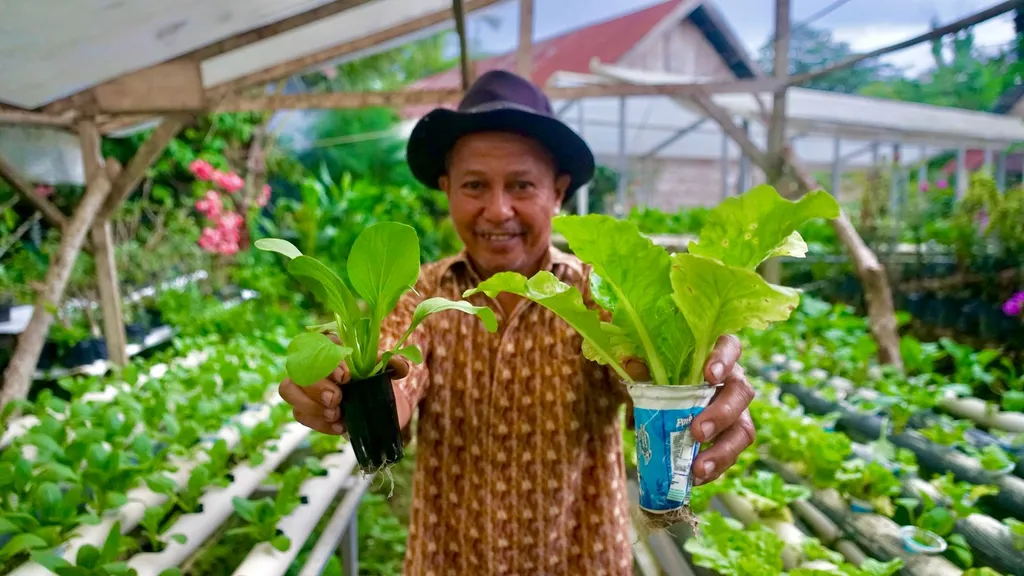
For more than 20 years, the garden in the heart of Kendari owned by Jamadu (59) has consistently served as a learning space for students and local residents. Starting as a decorative plant garden, it has now shifted its focus to hydroponic farming. Learning, planting, and sharing are the way of life that keeps him growing.
Three female internship students sat on a long bench at the home and garden of Jamadu (59) in Kendari City, Southeast Sulawesi. The vocational high school students from East Kolaka were busy sowing seeds to be planted in rows of hydroponic pipes. A light drizzle in the late afternoon added to the serene atmosphere in early March.
Jamadu observed attentively while occasionally giving instructions on how to sow the seeds in the provided trays. Those seeds would later grow into plants that sustain life.
“Planting must be considered even from the time of the seedling. Everything must be prepared, from the beginning to the final stage,” he said.
To every intern who comes, this father of two always asks about their orientation in farming. He emphasizes that those who come should gain many lessons to apply in the future, particularly in the field of agriculture.
Accompanying and mentoring students has been carried out by Jamadu since 2003. At that time, he was still gardening ornamental plants and vegetables grown conventionally. This began when his colleague, who was a teacher, requested that his students be allowed to intern.
He also began accepting students who came for internships. They learned how to plant, sow seeds, make compost fertilizer, and handle pests. From a few individuals to dozens of people in one group.
Planting must be considered even from the seed. Prepare everything, from the beginning to the final stage.
At his residence, he even built a special room for students who come. Not only students, but various institutions also often use his garden as a learning site.
“We were then appointed as one of the Self-Reliant Agricultural and Rural Training Centers (P4S) in Kendari. Alhamdulillah, out of the four appointed, we have remained active and operational,” he explained.
Learn to fail
Tenacity and willingness to share did not just grow. Jamadu grew up on campus and on the streets. When his studies at the Faculty of Agriculture, Halu Oleo University, were over, he had difficulty collecting money to finish his thesis. It was also difficult to eat. As a village boy, he survived through various means.
He then decided to travel to many areas in Indonesia. In one area, he did anything to get by and survive. After some time he moved to another city and did the same thing. On the streets, he gained a lot of knowledge and experience.
“In Luwuk I was pickpocketed, but ended up being friends with them. In total, I traveled around for four years, to Bitung, Taliabo, Banggai, until I finally came home,” he added.
After some time traveling around, he decided to go back and finish his studies. During that time, he got help from one of his lecturers. It was a reminder for him to continue sharing and doing good for others.
One day, he saw a grocery store he often passed also selling flowers in pots. At that time, selling ornamental plants was not yet a trend. He looked deeper and saw the potential in it.
With a capital of Rp 3,500 in 1993, he bought asoka flowers. He borrowed his friend’s land to plant. As a final year agriculture student, he was indeed fond of planting and had sufficient knowledge.
The plants were growing well, and people began to recognize them. However, he did not sell them yet, only using a barter system. Ashoka flowers were replaced with other flowers. So for years until his garden was quite busy.
Until 1997, in a flower exhibition, he began to appear. His flowers sold for Rp 15,000, a fairly large number at that time. He became more active in planting and trading ornamental plants.
“I dared to go to Malang, bringing Rp 800,000 to buy flowers. In Kendari, I planted them again. In less than two months, the return was doubled. It turns out that if we pursue something further, there is a certain market for other people,” he explained.
Years later, he began to move to the land owned by his wife, Suswati (60). Slowly, he bought some of the land around his house until now it has reached one hectare. Everything was bought from the results of the plants. Not only flowers, he also planted vegetables and food crops.
Urban farming
As he was no longer young, and the potential of ornamental plants did not develop rapidly, Jamadu and his wife began to think long term. Conventional plants require a lot of energy and time. He had to hoe, cut grass, and weed the plants every day. His back was not as healthy as before.
We were then appointed as one of the Self-Help Agricultural and Rural Training Centers (P4S) in Kendari. Alhamdulillah, out of the four appointed, we are still surviving and active.
“After my wife and I discussed it, hydroponics became something that caught our attention. We started learning from people who had already entered this field,” he said.
Jamadu started with one hydroponic rack by planting kale. The first attempt failed. He tried again, and still failed. And so on until planting six times. One time planting he spent a total of around Rp 1 million.
He began to waver. He felt that hydroponic techniques did not suit him. However, his wife, Suswati, encouraged him to study more intensively. He decided to go to Surabaya to a hydroponic planting training center.
“Failure means having to keep learning. Farmers like me take profits and losses later, the important thing is being able to plant means being able to survive,” said Jamadu.
There, he learned how to make planting media, sowing, water and nutrient needs, and harvest. The knowledge he gained was then applied, and succeeded. He then started planting pak choi, lettuce, and kale.
The next challenge lies ahead. The harvested vegetables do not know where to sell them. There are many traders in the market, and in modern shopping centers it is difficult to get space.
He then decided to go around and distribute vegetables to rows of shops on the main road of Kendari. Free. He did it to introduce his product. He was rejected countless times even though he offered it for free. For those who accepted, he left a telephone number that could be contacted if they were interested in buying.
From there, the doors of his business began to open. One by one, buyers came. His hydroponic plants grew. He continued to regularly attend training both in Kendari and outside the city. For him, learning is a way to survive and grow.
Now, he has many regular customers. From restaurants, retailers, to companies. His land, which was initially limited, has now grown to one hectare with a variety of vegetables. He still regularly receives students and local people who want to learn how to plant.
For Jamadu, being a farmer and sharing are requirements for growth. “The garden is not just a place to plant, but a place to learn together. And sharing makes us happy, knowledge is used and we continue to exist as humans,” said Jamadu who until now does not know the meaning of his own name. “I didn’t have time to ask my father, he died when I was little,” he joked.
Jamadu
Born: Kampung Baru, North Buton 8 January 1966 Wife: Suswati (60) Education: Bachelor of Agriculture, Halu Oleo University (1985-1994) Activities: Lecturer at the Nuri Horti Kendari Independent Agriculture and Rural Training Center (P4S)
For more than 20 years, the garden in the heart of Kendari owned by Jamadu (59) has consistently served as a learning space for students and local residents. Starting as a decorative plant garden, it has now shifted its focus to hydroponic farming. Learning, planting, and sharing are the way of life that keeps him growing.
Three female internship students sat on a long bench at the home and garden of Jamadu (59) in Kendari City, Southeast Sulawesi. The vocational high school students from East Kolaka were busy sowing seeds to be planted in rows of hydroponic pipes. A light drizzle in the late afternoon added to the serene atmosphere in early March.
Jamadu observed attentively while occasionally giving instructions on how to sow the seeds in the provided trays. Those seeds would later grow into plants that sustain life.
“Planting must be considered even from the time of the seedling. Everything must be prepared, from the beginning to the final stage,” he said.
To every intern who comes, this father of two always asks about their orientation in farming. He emphasizes that those who come should gain many lessons to apply in the future, particularly in the field of agriculture.
Accompanying and mentoring students has been carried out by Jamadu since 2003. At that time, he was still gardening ornamental plants and vegetables grown conventionally. This began when his colleague, who was a teacher, requested that his students be allowed to intern.
He also began accepting students who came for internships. They learned how to plant, sow seeds, make compost fertilizer, and handle pests. From a few individuals to dozens of people in one group.
Planting must be considered even from the seed. Prepare everything, from the beginning to the final stage.
At his residence, he even built a special room for students who come. Not only students, but various institutions also often use his garden as a learning site.
“We were then appointed as one of the Self-Reliant Agricultural and Rural Training Centers (P4S) in Kendari. Alhamdulillah, out of the four appointed, we have remained active and operational,” he explained.
Learn to fail
Tenacity and willingness to share did not just grow. Jamadu grew up on campus and on the streets. When his studies at the Faculty of Agriculture, Halu Oleo University, were over, he had difficulty collecting money to finish his thesis. It was also difficult to eat. As a village boy, he survived through various means.
He then decided to travel to many areas in Indonesia. In one area, he did anything to get by and survive. After some time he moved to another city and did the same thing. On the streets, he gained a lot of knowledge and experience.
“In Luwuk I was pickpocketed, but ended up being friends with them. In total, I traveled around for four years, to Bitung, Taliabo, Banggai, until I finally came home,” he added.
After some time traveling around, he decided to go back and finish his studies. During that time, he got help from one of his lecturers. It was a reminder for him to continue sharing and doing good for others.
One day, he saw a grocery store he often passed also selling flowers in pots. At that time, selling ornamental plants was not yet a trend. He looked deeper and saw the potential in it.
With a capital of Rp 3,500 in 1993, he bought asoka flowers. He borrowed his friend’s land to plant. As a final year agriculture student, he was indeed fond of planting and had sufficient knowledge.
The plants were growing well, and people began to recognize them. However, he did not sell them yet, only using a barter system. Ashoka flowers were replaced with other flowers. So for years until his garden was quite busy.
Until 1997, in a flower exhibition, he began to appear. His flowers sold for Rp 15,000, a fairly large number at that time. He became more active in planting and trading ornamental plants.
“I dared to go to Malang, bringing Rp 800,000 to buy flowers. In Kendari, I planted them again. In less than two months, the return was doubled. It turns out that if we pursue something further, there is a certain market for other people,” he explained.
Years later, he began to move to the land owned by his wife, Suswati (60). Slowly, he bought some of the land around his house until now it has reached one hectare. Everything was bought from the results of the plants. Not only flowers, he also planted vegetables and food crops.
Urban farming
As he was no longer young, and the potential of ornamental plants did not develop rapidly, Jamadu and his wife began to think long term. Conventional plants require a lot of energy and time. He had to hoe, cut grass, and weed the plants every day. His back was not as healthy as before.
We were then appointed as one of the Self-Help Agricultural and Rural Training Centers (P4S) in Kendari. Alhamdulillah, out of the four appointed, we are still surviving and active.
“After my wife and I discussed it, hydroponics became something that caught our attention. We started learning from people who had already entered this field,” he said.
Jamadu started with one hydroponic rack by planting kale. The first attempt failed. He tried again, and still failed. And so on until planting six times. One time planting he spent a total of around Rp 1 million.
He began to waver. He felt that hydroponic techniques did not suit him. However, his wife, Suswati, encouraged him to study more intensively. He decided to go to Surabaya to a hydroponic planting training center.
“Failure means having to keep learning. Farmers like me take profits and losses later, the important thing is being able to plant means being able to survive,” said Jamadu.
There, he learned how to make planting media, sowing, water and nutrient needs, and harvest. The knowledge he gained was then applied, and succeeded. He then started planting pak choi, lettuce, and kale.
The next challenge lies ahead. The harvested vegetables do not know where to sell them. There are many traders in the market, and in modern shopping centers it is difficult to get space.
He then decided to go around and distribute vegetables to rows of shops on the main road of Kendari. Free. He did it to introduce his product. He was rejected countless times even though he offered it for free. For those who accepted, he left a telephone number that could be contacted if they were interested in buying.
From there, the doors of his business began to open. One by one, buyers came. His hydroponic plants grew. He continued to regularly attend training both in Kendari and outside the city. For him, learning is a way to survive and grow.
Now, he has many regular customers. From restaurants, retailers, to companies. His land, which was initially limited, has now grown to one hectare with a variety of vegetables. He still regularly receives students and local people who want to learn how to plant.
For Jamadu, being a farmer and sharing are requirements for growth. “The garden is not just a place to plant, but a place to learn together. And sharing makes us happy, knowledge is used and we continue to exist as humans,” said Jamadu who until now does not know the meaning of his own name. “I didn’t have time to ask my father, he died when I was little,” he joked.
Jamadu
Born: Kampung Baru, North Buton 8 January 1966 Wife: Suswati (60) Education: Bachelor of Agriculture, Halu Oleo University (1985-1994) Activities: Lecturer at the Nuri Horti Kendari Independent Agriculture and Rural Training Center (P4S)

:quality(80):watermark(https://cdn-content.kompas.id/umum/kompas_main_logo.png,-16p,-13p,0)/https://cdn-dam.kompas.id/images/2025/03/26/7b2ea85d83b134d6352212ab7f0febb0-WhatsApp_Image_2025_03_26_at_15.04.43.jpeg)
:quality(80):watermark(https://cdn-content.kompas.id/umum/kompas_main_logo.png,-16p,-13p,0)/https://cdn-dam.kompas.id/images/2025/03/13/c18ea60796e2b501757c8a5f5be7fe14-IMG_4988.jpeg)
:quality(80):watermark(https://cdn-content.kompas.id/umum/kompas_main_logo.png,-16p,-13p,0)/https://cdn-dam.kompas.id/images/2025/03/26/9a381cc4ffc2faf0a3a55ccb0b29f985-WhatsApp_Image_2025_03_26_at_15.04.41.jpeg)
:quality(80):watermark(https://cdn-content.kompas.id/umum/kompas_main_logo.png,-16p,-13p,0)/https://cdn-dam.kompas.id/photo/ori/2022/05/17/cdb41594-c528-4780-91a9-9a0480649561.jpg)
:quality(80):watermark(https://cdn-content.kompas.id/umum/kompas_main_logo.png,-16p,-13p,0)/https://cdn-dam.kompas.id/images/2025/03/26/f129fc2efdc7a67ea9d6c688c3a70895-WhatsApp_Image_2025_03_26_at_15.04.42.jpeg)